
Loading the cabinet…
Drag to turn it
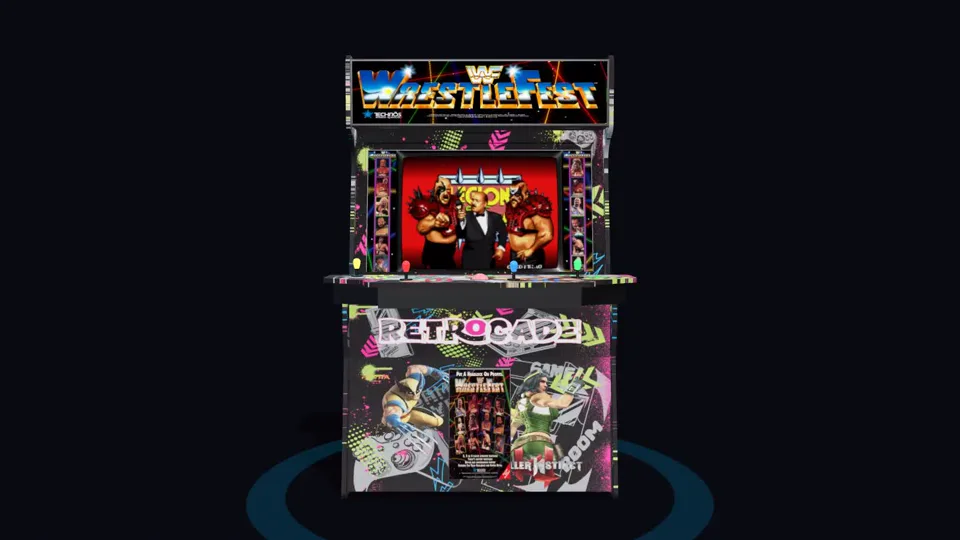
Depiction, not a photograph. The cabinet and its panels come from the Final Boss's own CAD; the PC, speakers, subwoofer and board are the real parts at real size, shown where a builder would fit them; the screens and the wiring are drawn to illustrate.
Built like furniture. Plays like 1982.
An arcade breakdown — what's actually inside a Phantom, and why it outlasts the flat-pack alternatives.
All-plywood advantage
Every cabinet is built from 3/4″ furniture-grade birch plywood — because an arcade meant to last decades shouldn't be built from particle board. Plywood is lighter, dramatically stronger, and holds its shape through years of humidity and handling. The entire cabinet is then finished in a durable layer of black laminate.
Using a slim LCD screen means a Phantom is about half the depth of a traditional arcade cabinet — easier to move, and it saves space in your game room.
Whole-cabinet artwork
An arcade isn't just a gaming machine — it's a piece of art. Phantom's graphic artists design the artwork around you: show off your favourite games, or keep it subtle and let it blend into the room.
Prints start with thick air-release vinyl in a matte finish, protected by a thick polycarbonate matte laminate to keep it vibrant for years. The industry standard is to wrap just the control panel — Phantom wraps the whole arcade.
LED & RGB buttons
LED buttons come standard on every arcade — when the machine turns on, so do the buttons.
Upgrade to a controller and the buttons illuminate only when the game needs them — load a game and look down: exactly the buttons that game uses are lit. Go one step further with RGB buttons and each one also changes colour to match the original cabinet's button colours for that game.
LCD kick panel
On the front of the kick panel — where the coin door would normally sit — you can fit a vertically mounted screen. When a game loads, the matching arcade flyer for that game is displayed. No other detail sells the arcade feeling harder.
Commercial-grade controls
Authentic commercial-grade arcade parts throughout — the same joysticks, buttons and trackballs the originals used, rated for arcade-floor abuse, not living-room duty.
The Final Boss · the flagship
What that build looks like at the top of the range
Everything above is how every Phantom is made. This is the parts list on the biggest one — the four-player Final Boss, where the things other builders sell as upgrades are simply in it.
Three screens
- 48″ LG UltraGear OLED
- The main screen. OLED lights each pixel on its own, so a black playfield is actually black and there is no backlight halo around bright sprites. That matters more here than on a TV, because most of these games are bright objects on a dark field.
- Active marquee · 48″, custom
- Where most cabinets have a back-lit print of one game, this changes to each game’s own artwork as you scroll, and becomes a DMD score display when you load pinball. Custom-made for this cabinet, at the shape and size an arcade marquee should be.
- Active kick panel · 21″
- The third screen, set into the base below the control deck. All three change together as you browse.
Four stations of controls
- 53″ four-player deck
- Four inches proud of the cabinet on each side. The middle two stations get a joystick and six buttons in the classic two-row layout; the ends get a joystick and a four-button diamond. Start and coin run along the back edge.
- (4) iL Competition 8-way sticks
- Industrias Lorenzo Eurojoysticks — the same sticks fitted to commercial cabinets — in each player’s colour, mounted through the deck’s real hole pattern.
- 3″ trackball
- Centre of the deck, for Golden Tee, Centipede and Marble Madness.
- RGB buttons · Ultimarc PacLED64
- Illuminated UltraLux pushbuttons on an LED controller: they light only the buttons the game actually uses, and change colour to match that cabinet’s original panel.
- (2) Sinden light guns
- Recoil, and over 300 light-gun games. The modern kind that works on a flat panel — old CRT-style guns do not.
- (2) guitar controllers
- Over 800 songs, on the same PC as everything else. Switching from a fighter to a rhythm game is a menu pick, not a cable swap.
- Soft-close accessory drawer
- Hidden under the deck, lined with foam egg-crate. Guns, controllers, wheel and guitars live in there between sessions.
Cabinet, sound and games
- Klipsch ProMedia 2.1
- Satellites on the speaker shelf built into the cabinet behind the marquee band, subwoofer in the base. The same system Klipsch sells for desktop gaming.
- Custom-built gaming PC
- In the base, behind the side panel: a real PC, not a bare arcade board. Dennis builds it first, and it can be specced up from there.
- 20,000+ games · arcade to PS3
- The Next-Gen Gamer package, browsed through the LaunchBox front-end so choosing a game feels like an arcade rather than a desktop.
- Custom-designed graphics
- No catalogue of themes. The artwork is worked out one-on-one with Dennis, from a theme, a colour, a family name or a favourite game, and printed in-house.
- T-molding in your colour
- Pressed into a routed slot around every exposed edge, the way a real cabinet is finished. An RGB LED outline round the whole machine is available.
- (4) 2″ casters
- So a machine 53″ wide, 34″ deep and 78″ tall still rolls out for four players and back against the wall afterwards.
Standard on a new Final Boss. The smaller Phantoms are built the same way — the parts list is what changes.
Every feature, in detail →